
Full Mouth Implants vs Traditional Dentures: 2026 Guide
Table of Contents
Full Mouth Implants vs Traditional Dentures: Quick Comparison
Comparison Table
How Full-Mouth Dental Implants Work
How Traditional Dentures Work
Traditional Dentures Pros and Cons
Stability, Comfort, and Chewing Ability
Full Mouth Dental Implant Cost and Long-Term Value
How Long Do Full Mouth Dental Implants Last
Implant-Supported Dentures vs Traditional Dentures
Frequently Asked Questions
Last Updated: October 17, 2026
Full Mouth Implants vs Traditional Dentures: Quick Comparison
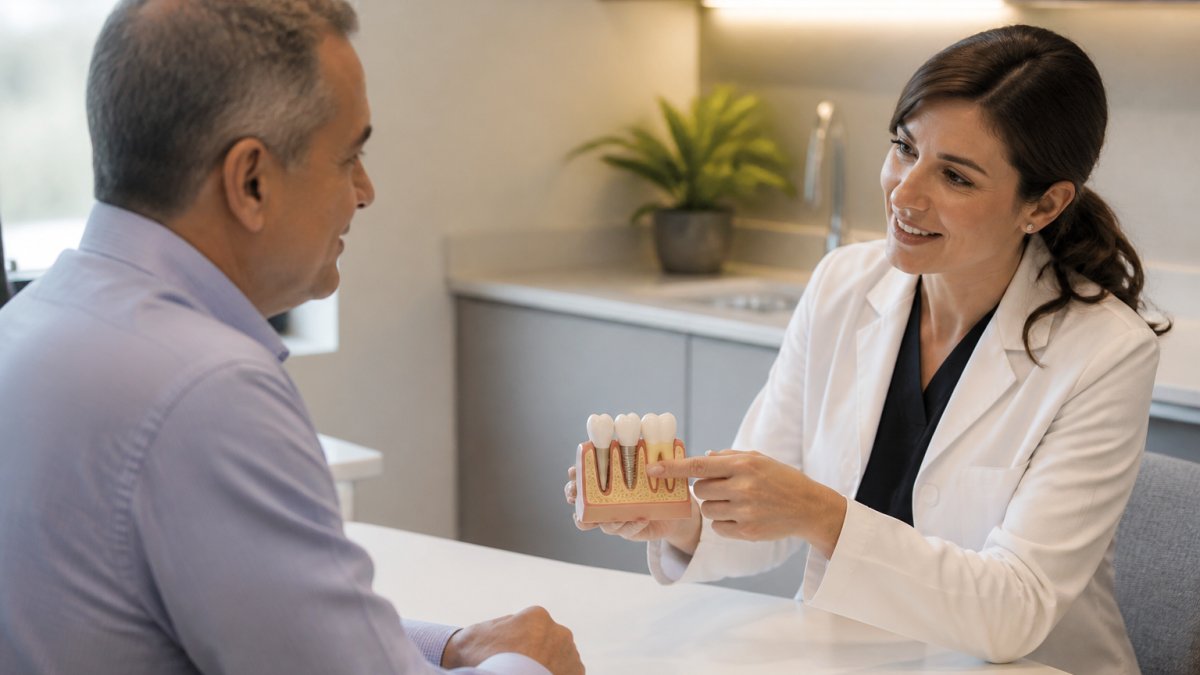
Choosing between full mouth implants vs traditional dentures is one of the most significant dental decisions you'll make. Both solutions restore your ability to eat, speak, and smile with confidence, but they work in fundamentally different ways, come with different costs, and require different levels of daily maintenance.

At Royal Dental at The Villages, we help patients navigate this choice every day. The decision isn't simply about which option is "better." It's about which aligns with your lifestyle, budget, medical situation, and long-term priorities. Some patients thrive with implants. Others find traditional dentures perfectly suited to their needs.
Here's what separates them: full mouth implants are surgically anchored into your jawbone and function like natural teeth. Traditional dentures rest on your gums and are removable. That single difference cascades into everything else, how they feel, how much they cost, how long they last, and how much daily care they demand.
Comparison Table
Feature | Full Mouth Implants | Traditional Dentures |
Upfront Cost | Higher initial investment | Lower starting cost |
Stability & Retention | Permanently fixed, no slipping | Removable, may shift during eating |
Chewing Ability | Near-natural bite force | Reduced chewing power |
Appearance | Indistinguishable from natural teeth | Can look natural with proper fit |
Daily Maintenance | Brush and floss like natural teeth | Daily removal, cleaning, soaking |
Bone Preservation | Stimulates jawbone, prevents loss | Jawbone continues to shrink over time |
Lifespan | 20-30+ years with proper care | 5-7 years before replacement needed |
Recovery Time | 3-6 months for full integration | Immediate wear (adjustments needed) |
Reversibility | Surgical procedure, not reversible | Easily discontinued anytime |
Best For | Active lifestyles, long-term value | Budget-conscious, immediate results |
How Full-Mouth Dental Implants Work
Full mouth implants replace your entire set of upper or lower teeth using a surgical framework anchored directly into your jawbone. The process begins with a titanium implant post being placed into the bone where your tooth root once was. Over several months, your bone fuses with the implant through a biological process called osseointegration.
What makes this approach powerful is that the implant actually stimulates your jawbone, preventing the bone loss that naturally occurs after tooth loss. Your jawbone stays dense and maintains its shape. This is a critical difference from dentures, which sit on top of your gums and do nothing to stop the gradual shrinking of bone underneath.
Modern full-mouth implant solutions come in several forms. All-on-4 implants use just four strategically placed implants to support a full arch of teeth. Implant-supported dentures use more implants, typically six to eight, to anchor a denture that snaps or is permanently bonded in place. Full-arch restorations use individual implants for each tooth position.
Recovery takes time. After implant placement, you'll typically wait three to six months before the final restoration is attached. During this period, you can wear a temporary denture. Once complete, your implants require no special care beyond regular brushing, flossing, and dental checkups, exactly like natural teeth.
How Traditional Dentures Work
Traditional dentures are custom-made replacements that rest on your gums and remaining bone. They're held in place by suction and the contour of your mouth. Your dentist takes impressions of your mouth, sends them to a lab, and a technician crafts dentures that fit your specific anatomy.
From the moment you receive them, dentures are ready to wear. There's no surgical recovery, no waiting period. You can eat and speak immediately, though an adjustment period of a few weeks is typical as your mouth adapts to the new appliance.
The denture base is usually made from acrylic resin, and the teeth are either acrylic or porcelain. Quality varies significantly. A well-fitting, high-quality denture can look remarkably natural. A poorly fitting one will shift when you eat, affect your speech, and cause discomfort.
Dentures require daily removal and cleaning. You soak them overnight in a cleaning solution, brush them with a denture brush, and rinse them before reinserting. Many patients also use denture adhesive to improve retention throughout the day.
Over time, your jawbone shrinks as the bone beneath the denture resorbs. This is a natural consequence of tooth loss and continued by the pressure of the denture sitting on top. As bone shrinks, the denture's fit loosens. You'll need periodic adjustments and relines to maintain a secure fit.
Traditional Dentures Pros and Cons
Pros:
Lower upfront cost: Starting prices for traditional dentures are significantly lower than implants, making them accessible for budget-conscious patients
No surgery required: Completely non-invasive; no surgical recovery, no downtime
Immediate results: You can wear them the day they're made
Reversible: You can discontinue use anytime without permanent changes to your mouth
Easier extraction if needed: If your situation changes, removing dentures involves no surgical procedure
No bone loss risk from surgery: You avoid the surgical intervention that implants require
Cons:
Continuous bone loss: Your jawbone shrinks over time, requiring periodic adjustments and relines
Reduced chewing ability: Dentures typically provide only 25% of the bite force of natural teeth, limiting your food choices
Daily maintenance burden: Removal, cleaning, and soaking are required every day
Potential for slipping: Dentures can shift during eating, speaking, or laughing, especially without adhesive
Speech changes: Many patients experience altered speech patterns initially and sometimes permanently
Gum irritation: Prolonged wear can cause sore spots and tissue irritation
Frequent replacement: Most dentures need replacement every 5-7 years
Aesthetic limitations: While quality dentures look good, they may not match the natural appearance of implants
Adjustment period: It takes weeks to adapt to wearing a denture
Stability, Comfort, and Chewing Ability
This is where the gap between full mouth implants and traditional dentures becomes most apparent in daily life.
Full mouth implants are fixed permanently in your mouth. They don't move, shift, or slip. You can eat crunchy foods, bite into apples, and chew normally.
Traditional dentures require adjustment. Your chewing ability is limited because the denture can shift under pressure. Hard, sticky, and crunchy foods become problematic. Many patients unconsciously modify their diet, avoiding nuts, popcorn, raw vegetables, and chewy meats. Over time, this dietary restriction can affect nutrition.
Speech is affected differently by each option. Implants cause no speech changes because they're fixed in place. Dentures can alter how you pronounce certain sounds, particularly those requiring tongue contact with the roof of your mouth. Some patients adapt completely within weeks. Others experience permanent changes.
Comfort varies individually. A well-fitted denture can be comfortable for daily wear. A poorly fitted one causes constant irritation, sore spots, and aching. Implants, once healed, feel like natural teeth, no discomfort, no adjustment needed.
The stability difference becomes most obvious during social situations. Denture wearers often experience anxiety about their dentures shifting during conversation or eating in public. Implant patients have no such concern.
Full Mouth Dental Implant Cost and Long-Term Value
Understanding the true cost of full mouth implants requires looking beyond the initial price tag to the long-term value equation.
Implants carry a higher upfront cost than dentures. However, the longevity of implants makes them more economical over decades. A full-mouth implant restoration can last 20-30 years or longer with proper care. Traditional dentures need replacement every 5-7 years, and each replacement carries its own cost.
When you factor in the replacement cycles, a patient might need four or five sets of dentures over 25 years, the lifetime cost of dentures often approaches or exceeds the cost of implants. Additionally, each denture replacement involves new impressions, lab work, and adjustment appointments.
The financial picture also includes indirect costs. Denture wearers often spend money on adhesives, cleaning solutions, and relines. They may also incur costs from dietary changes or nutritional supplements if their reduced chewing ability limits their food intake.
Many dental offices offer financing options to make implants more accessible. Royal Dental at The Villages provides flexible payment plans and can discuss financing with you during your consultation.
Insurance coverage varies. Traditional dentures are more likely to be partially covered by dental insurance. Implants may receive limited coverage or none at all, depending on your plan. Discuss your specific coverage with your insurance provider and your dental office.
How Long Do Full Mouth Dental Implants Last
Full mouth dental implants are designed to be a permanent solution. With proper care, implants can function for 20-30 years or longer, often lasting a lifetime.
The titanium implant post itself is extraordinarily durable. Titanium is biocompatible and doesn't decay or corrode in the mouth. The main factor determining implant longevity is whether osseointegration, the fusion of bone and implant, is successful and remains stable.
The crown or bridge attached to the implant has a finite lifespan. Crowns typically last 10-15 years before they may need replacement due to wear, chipping, or material degradation. This is significantly longer than denture lifespan but shorter than the implant itself.
Implant success depends on several factors. Good oral hygiene is essential, you must brush, floss, and have regular professional cleanings just like with natural teeth. Smoking significantly reduces implant success rates and longevity. Uncontrolled diabetes can compromise bone health and implant stability.
Regular dental checkups allow your dentist to monitor implant health, check for any bone loss, and address problems early. Most implant failures occur within the first year after placement. After that, success rates exceed 95%.
Implants can be repaired if a crown cracks or a screw loosens. The implant post itself rarely fails, but if it does, a new implant can be placed in most cases.
Implant-Supported Dentures vs Traditional Dentures
Implant-supported dentures represent a middle ground between full-mouth implants and traditional dentures. They combine the stability of implants with the removability and lower cost of dentures.
An implant-supported denture is anchored to the jawbone using four to eight implants. The denture snaps onto attachments on these implants, creating a much more stable restoration than a traditional denture.
The advantages over traditional dentures are significant. Implant-supported dentures provide much better stability, they don't move during eating or speaking. Chewing ability improves because the denture doesn't shift under pressure.
The disadvantages compared to fixed full-mouth implants are also worth noting. You still must remove and clean the denture daily. The initial cost is higher than traditional dentures but lower than fixed full-mouth implants.
Implant-supported dentures typically last longer than traditional dentures, often 10-15 years, because the implant anchors prevent the accelerated bone loss that undermines traditional denture fit.
For patients who want better stability and function than traditional dentures but prefer a removable solution or face budget constraints, implant-supported dentures offer a compelling option.
Choosing between full mouth implants and traditional dentures is deeply personal. We offer same-day implants and can discuss financing options that fit your budget. Contact us today to learn which solution is right for you.
Frequently Asked Questions
What is better: full mouth implants or traditional dentures?
Full mouth implants offer superior stability, comfort, and chewing ability, with no daily removal needed. Traditional dentures cost less upfront but require daily cleaning, adjustments, and replacement every 5-7 years. The best choice depends on your budget, bone health, medical history, and lifestyle preferences. Those prioritizing long-term comfort and minimal maintenance typically prefer implants; those seeking lower initial costs may choose dentures. Consult with a dental professional to evaluate your candidacy for each option.
How much do full mouth dental implants cost compared with traditional dentures?
Actual pricing depends on bone condition, number of implants needed, and treatment complexity. Contact Royal Dental at The Villages for a personalized quote and to discuss financing options.
How long do full mouth dental implants last?
Full-mouth dental implants can last 20-30 years or longer with proper care, making them a durable long-term solution. The implants themselves often outlast the replacement teeth (crowns or bridges), which may need replacement after 15-20 years. Traditional dentures typically need replacement every 5-7 years due to wear and changes in jawbone shape. Implant longevity depends on oral hygiene, bone health, and regular dental maintenance.
Can you really complete a full-mouth restoration in 24 hours?
Same-day or 24-hour full-mouth restorations are possible with advanced planning and technology, though the timeline depends on your specific situation. Some patients receive temporary teeth immediately after implant placement, with final custom teeth fitted after osseointegration (bone healing). Others require a phased approach due to bone density or medical factors. Royal Dental at The Villages specializes in accelerated treatment timelines and can assess whether you're a candidate during a consultation.
What are the risks and complications of full mouth implants versus traditional dentures?
Implant risks include infection, implant failure (1-5% of cases), nerve damage, and sinus complications, though these are rare with experienced providers. Recovery typically takes 3-6 months for full osseointegration. Denture complications include poor fit, sore spots, difficulty eating, speech changes, and bone loss over time. Implants preserve jawbone; dentures accelerate bone loss. Medical conditions like uncontrolled diabetes or severe bone loss may affect implant candidacy. Discuss your health history with your dentist to identify your risk profile.
Inquiry Services Page


Comments