
Natural Looking Full Mouth Dental Restorations: A Complete Guide
Table of Contents
What Makes a Full Mouth Dental Restoration Look NaturalThe Role of Digital Smile DesignShade Matching and Color Harmony
The Role of Digital Smile Design
Shade Matching and Color Harmony
Types of Full Mouth Restoration OptionsImplant-Supported Bridges vs. Implant-Retained DenturesFull-Arch Restoration and Prosthetic Teeth
Implant-Supported Bridges vs. Implant-Retained Dentures
Full-Arch Restoration and Prosthetic Teeth
Aesthetic Dental Crown Materials and Their ImpactPorcelain-Fused-to-Metal vs. Zirconia CrownsBiocompatible Materials for Long-Term Success
Porcelain-Fused-to-Metal vs. Zirconia Crowns
Biocompatible Materials for Long-Term Success
Full Mouth Dental Implants Cost: What You Should KnowFactors That Affect PricingLong-Term Maintenance Costs and Hidden Fees
Factors That Affect Pricing
Long-Term Maintenance Costs and Hidden Fees
Full Mouth Restoration Recovery TimelineImmediate Post-Procedure CareOsseointegration and Healing PhasesDietary Adjustments During Recovery
Immediate Post-Procedure Care
Osseointegration and Healing Phases
Dietary Adjustments During Recovery
The Restoration Process: What Happens Step by StepInitial Assessment and Treatment PlanningImplant Placement and Same-Day OptionsCustom Fabrication and Bite Alignment
Initial Assessment and Treatment Planning
Implant Placement and Same-Day Options
Custom Fabrication and Bite Alignment
Maintaining Your Natural-Looking SmileDaily Care and Oral HygieneProfessional Maintenance and Adjustments
Daily Care and Oral Hygiene
Professional Maintenance and Adjustments
Frequently Asked Questions
Last Updated: September 1, 2026
What Makes a Full Mouth Dental Restoration Look Natural
The difference between a restoration that looks obviously fake and one that blends seamlessly comes down to three critical factors: shade matching, anatomical proportion, and translucency. A natural looking full mouth dental restoration doesn't announce itself, people see your smile, not your dentistry.

At Royal Dental at The Villages, we understand that achieving this naturalness requires precision at every stage. The teeth need to match your bone structure, skin tone, and facial proportions. Too bright and the restoration screams "fake." Too dark and it looks dull and aged.
The Role of Digital Smile Design
Digital smile design transforms guesswork into precision. Rather than making assumptions, we use imaging software to analyze your facial geometry, lip line, and bone structure, showing you exactly what your smile will look like before any work begins.
This matters because restoration success depends on proportions matching your face. A tooth width-to-height ratio that works for one person creates an unnatural appearance in another. You see mockups on screen, approve the direction, and lab technicians have exact specifications to follow. The result is a restoration that looks like it belongs to your face.
Shade Matching and Color Harmony
Shade matching involves far more than picking a color from a swatch. Natural teeth have depth, lighter at the edges, slightly darker toward the center, with translucency that varies by tooth type. A restoration that ignores this depth looks flat and artificial under normal lighting.
We analyze your existing natural teeth under different lighting conditions, documenting base shade, translucency level, and color variations. Custom-fabricated restorations are then tinted to replicate these characteristics, shifting subtly in different light just like natural teeth do.
Types of Full Mouth Restoration Options
Your restoration approach depends on bone density, budget, timeline, and personal preference. Understanding the differences helps you make an informed decision.
Implant-Supported Bridges vs. Implant-Retained Dentures
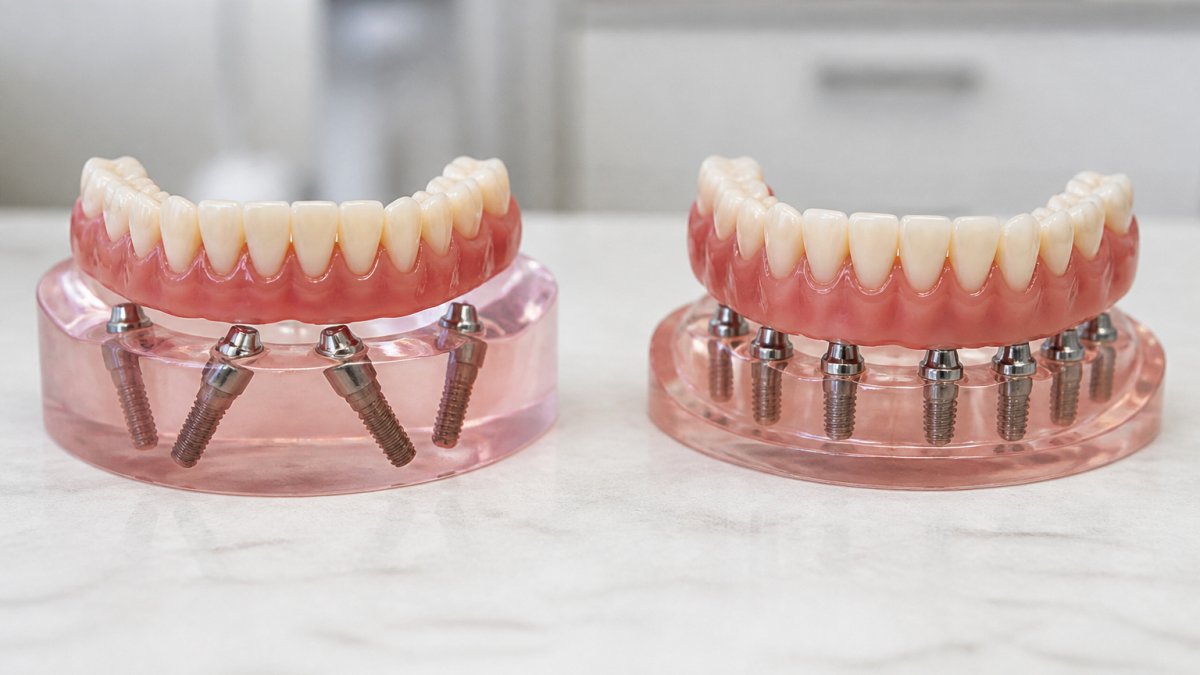
An implant-supported bridge uses multiple dental implants as anchors for a fixed prosthetic bridge. It's permanently attached and cleaned like natural teeth. This approach preserves more jawbone over time because implants stimulate bone continuously.
Implant-retained dentures snap onto implant posts and are removed daily for cleaning. They're less invasive initially and often cost less upfront. However, the denture base still rests on gum tissue, so some bone loss continues over time, though slower than with traditional dentures.
Bridges feel more like natural teeth and preserve bone better, but require more implants and higher initial investment. Dentures are more affordable and easier to adjust, but require daily removal and eventual adjustments as bone resorbs.
Full-Arch Restoration and Prosthetic Teeth
Full-arch restoration means replacing all teeth in one or both arches. A full mouth dental restoration replaces both arches simultaneously with custom-fabricated prosthetic teeth matched to your facial proportions.
Same-day options exist where implants are placed and temporary teeth are attached in a single appointment. This appeals to patients who cannot take extended time off work. However, same-day restorations are temporary. Permanent restoration happens after osseointegration, where bone fuses to implant posts, typically 4-6 months later.
Aesthetic Dental Crown Materials and Their Impact
The material you choose directly affects how natural the restoration looks and how long it lasts.
Porcelain-Fused-to-Metal vs. Zirconia Crowns
Porcelain-fused-to-metal crowns have a metal substructure with porcelain layered on top. The metal provides strength and the porcelain provides aesthetics. However, the metal base can create a slight gray line at the gum margin, particularly if gum recession occurs.
Zirconia crowns are milled from a single block of zirconia ceramic. They're stronger than porcelain-fused-to-metal and allow light to pass through more naturally. There's no metal base, so no gray line risk. Zirconia is also more biocompatible, gum tissue responds more favorably to it. The trade-off is cost: zirconia typically runs higher.
For a natural looking full mouth dental restoration, zirconia has become the material of choice because it replicates the translucency of natural teeth more accurately.
Biocompatible Materials for Long-Term Success
Biocompatibility matters because your mouth is a living environment. Materials that irritate gum tissue create inflammation, recession, and eventual failure. Zirconia and high-quality porcelain are both biocompatible.
The gum tissue response to your restoration material affects how natural it looks long-term. If the material causes inflammation, your gums recede, exposing the crown margin. Biocompatible materials prevent this by maintaining healthy gum tissue contact.
Material | Strength | Translucency | Biocompatibility | Best For |
Zirconia | Excellent | High | Excellent | Aesthetic front teeth, long-term durability |
Porcelain-fused-to-metal | Very good | Moderate | Good | Mixed aesthetic and functional needs |
Acrylic resin | Fair | Moderate | Fair | Temporary restorations only |
Full Mouth Dental Implants Cost: What You Should Know
Cost is often the barrier between considering restoration and pursuing it. Understanding what drives pricing helps you evaluate options realistically.
Factors That Affect Pricing
The number of implants required is the primary cost driver. A full mouth restoration might require 4-8 implants depending on bone density and restoration type (the American Dental Association). Each implant involves surgical placement, the implant post itself, and the abutment. More implants mean higher cost.
Bone grafting adds significant expense. If your jawbone has resorbed significantly, bone must be added before implants can be placed. This requires a separate surgical procedure and 4-6 months healing time.
The type of restoration affects cost. Same-day temporary restorations cost less than permanent custom-fabricated restorations. Implant-retained dentures cost less than implant-supported bridges. Material choice matters: zirconia costs more than porcelain-fused-to-metal.
Geographic location, surgeon experience, and facility overhead also influence pricing. These differences reflect the quality and safety standards you're paying for.
Long-Term Maintenance Costs and Hidden Fees
Many patients focus on upfront cost and overlook ongoing maintenance. Implant-supported restorations require professional cleaning annually. If the restoration needs adjustment or a crown needs replacement, that's an additional cost. Zirconia crowns last 15-20 years typically; porcelain-fused-to-metal may need replacement sooner (peer-reviewed research).
Implant-retained dentures require periodic adjustments as bone continues to resorb slightly. Every 3-5 years, the denture base may need relining to maintain proper fit.
The real financial picture requires understanding both immediate and long-term costs. A restoration that costs less upfront but requires frequent adjustments may cost more over 15 years than a more expensive option requiring minimal maintenance.
For realistic pricing specific to your situation, Royal Dental at The Villages provides detailed cost estimates during your consultation. New patients receive a 10% discount on dental work and implants, which can meaningfully reduce your initial investment.
Full Mouth Restoration Recovery Timeline
Understanding the healing timeline helps you plan work, social commitments, and realistic expectations.
Immediate Post-Procedure Care
The first 24 hours after implant placement are critical. Swelling peaks around day 3. You'll experience some discomfort, managed with prescribed pain medication. Most patients describe it as manageable rather than severe.
Bleeding is normal for the first few days. Avoid hot foods and drinks for the first week; they increase bleeding and swelling. Stick to soft foods: yogurt, smoothies, soup, mashed vegetables. Avoid straws, as suction can disturb the surgical site.
Sleep with your head elevated for the first few nights to reduce swelling. Ice packs for the first 48 hours help minimize inflammation. After 48 hours, warm compresses become more helpful.
Osseointegration and Healing Phases
Osseointegration is the biological process where bone fuses to the implant surface, typically taking 4-6 months for the lower jaw and 6-9 months for the upper jaw (peer-reviewed research). During this time, the implant integrates but doesn't yet bear full chewing force.
If you received temporary teeth, they're designed for light chewing only. Avoid hard or sticky foods. At the 4-6 month mark, your surgeon evaluates integration. If successful, the temporary restoration is replaced with your permanent custom-fabricated restoration.
Dietary Adjustments During Recovery
Weeks 1-2: Soft foods only, soups, smoothies, mashed potatoes, scrambled eggs, soft fish.
Weeks 3-8: Gradually introduce softer solid foods like cooked vegetables, soft bread, and tender chicken. Avoid anything hard or sticky.
Months 2-4: Continue avoiding very hard foods, but you can eat most normal foods with caution.
After permanent restoration (4-6 months): Full diet is possible, though some patients remain cautious with extremely hard foods indefinitely.
The Restoration Process: What Happens Step by Step
Understanding the actual procedure reduces anxiety and helps you prepare mentally.
Initial Assessment and Treatment Planning
Your first appointment involves comprehensive evaluation. Digital imaging shows bone density and volume. We assess your bite, facial proportions, and aesthetic goals. Digital smile design shows you mockups of your potential outcome before committing to treatment.
Treatment planning addresses bone grafting needs. If your jawbone has resorbed significantly, we discuss whether grafting is necessary and how it affects your timeline. This phase also covers IV sedation options. If you have dental anxiety, IV sedation allows you to sleep through the procedure, waking with implants placed and temporary teeth attached.

Implant Placement and Same-Day Options
Implant placement involves creating small openings in your jawbone and inserting titanium posts. The procedure takes 2-4 hours depending on the number of implants. With IV sedation, you experience none of this.
Same-day temporary teeth are attached to the implant posts immediately after placement, allowing you to leave with teeth in place. You can smile and eat soft foods. Psychologically, this is powerful, many patients report that having immediate teeth reduces anxiety dramatically.
The temporary restoration is not your final restoration. It's designed for function and appearance during healing. Your permanent restoration is custom-fabricated after osseointegration is complete.
Custom Fabrication and Bite Alignment
Once osseointegration is confirmed (typically 4-6 months), your permanent restoration is fabricated. The lab technician uses your digital smile design specifications to create restorations matching your facial proportions perfectly.
Shade matching happens at this stage with precision. Your final restoration is tinted to match your skin tone and facial characteristics. Gum contouring may be performed to ensure the gum line looks natural.
Bite alignment is critical. Your restoration must fit your bite perfectly. Multiple appointments may be needed to verify fit, make adjustments, and ensure everything feels natural before final placement.
Maintaining Your Natural-Looking Smile
Your restoration requires less care than natural teeth in some ways and similar care in others.
Daily Care and Oral Hygiene
Brush your restoration twice daily with a soft toothbrush and non-abrasive toothpaste. Avoid whitening toothpaste, which is unnecessarily abrasive. Floss daily, particularly around implant posts where gum disease can develop. Water flossers work well for implant-supported restorations.
Avoid habits that damage natural teeth: don't use your teeth to open packages, don't chew ice, don't grind your teeth. If you grind at night, a night guard protects your restoration.
Professional Maintenance and Adjustments
Annual professional cleaning is recommended. Your hygienist uses special instruments that won't scratch your restoration. We check fit and function and address concerns early.
Over time, your restoration may need minor adjustments as bite changes occur naturally. Crown replacement becomes necessary eventually, typically 15-20 years after placement depending on material and wear patterns. The implant posts remain in place; only the crown is replaced.
Maintain excellent oral hygiene and attend professional cleanings to prevent implant-related complications.
A full mouth dental restoration represents a significant investment in your quality of life. The ability to eat comfortably, smile confidently, and speak without worry transforms daily experience. Royal Dental at The Villages specializes in creating natural looking full mouth dental restorations that restore function and confidence. With 30 years of experience and same-day implant options, we handle the complete process in one practice. New patients receive a 10% discount on dental work and implants. Schedule your consultation to see what's possible for your smile.
=== FAQ ANSWERS (audit these too, same rules) ===
[1] Q: How do modern dental implants mimic the appearance of natural teeth? A: Modern implants achieve a natural appearance through several techniques. Digital smile design allows your dentist to plan the exact shape, size, and color before treatment begins. Custom-fabricated crowns are shade-matched to your existing teeth and adjacent restorations. The implant post itself integrates with your jawbone through osseointegration, providing the same structural support as natural tooth roots. Gum contouring and soft tissue management ensure the restoration sits naturally within your smile, and porcelain-fused-to-metal or zirconia materials reflect light similarly to natural enamel.
[2] Q: What is the most natural looking option for full mouth restoration? A: Implant-supported restorations typically offer the most natural appearance compared to traditional dentures. Full-arch restorations and implant-retained dentures provide superior aesthetic results because they preserve jawbone density, maintain proper facial structure, and allow for custom shade-matching. Zirconia crowns and porcelain-fused-to-metal options both deliver excellent aesthetics, though zirconia is increasingly preferred for its translucency and biocompatibility. The key to natural appearance lies in careful treatment planning, precise bite alignment, and custom fabrication tailored to your facial features and smile design.
[3] Q: How long does recovery take after full mouth dental implants? A: Recovery varies depending on the extent of your restoration. Immediate post-procedure swelling and discomfort typically subside within 3-5 days. Full osseointegration, the process where implant posts bond with your jawbone, takes 3-6 months. During this time, you can often use temporary restorations or dentures. Some patients receive permanent restorations within 24 hours using same-day implant technology, though the underlying bone continues healing for several months. Dietary adjustments are necessary initially; soft foods are recommended for the first 1-2 weeks, with gradual progression to normal eating as healing progresses.
[4] Q: What factors affect the cost of full mouth dental implants? A: Several variables influence full mouth dental implants cost: the number of implants needed, whether bone grafting is required, the type of prosthetic teeth selected, material choices (zirconia versus acrylic resin), and the complexity of your case. Additional factors include the need for tooth extractions, gum contouring, and whether you choose same-day restoration versus phased treatment. Long-term maintenance costs should also be considered, including periodic adjustments, professional cleanings, and potential repairs. Contact your dental provider for a detailed treatment plan and cost breakdown specific to your needs.
Frequently Asked Questions
Q: How do modern dental implants mimic the appearance of natural teeth?
A: Modern implants achieve a natural appearance through several techniques. Digital smile design allows your dentist to plan the exact shape, size, and color before treatment begins. Custom-fabricated crowns are shade-matched to your existing teeth and adjacent restorations. The implant post itself integrates with your jawbone through osseointegration, providing the same structural support as natural tooth roots. Gum contouring and soft tissue management ensure the restoration sits naturally within your smile, and porcelain-fused-to-metal or zirconia materials reflect light similarly to natural enamel.
Q: What is the most natural looking option for full mouth restoration?
A: Implant-supported restorations typically offer the most natural appearance compared to traditional dentures. Full-arch restorations and implant-retained dentures provide superior aesthetic results because they preserve jawbone density, maintain proper facial structure, and allow for custom shade-matching. Zirconia crowns and porcelain-fused-to-metal options both deliver excellent aesthetics, though zirconia is increasingly preferred for its translucency and biocompatibility. The key to natural appearance lies in careful treatment planning, precise bite alignment, and custom fabrication tailored to your facial features and smile design.
Q: How long does recovery take after full mouth dental implants?
A: Recovery varies depending on the extent of your restoration. Immediate post-procedure swelling and discomfort typically subside within 3-5 days. Full osseointegration, the process where implant posts bond with your jawbone, takes 3-6 months. During this time, you can often use temporary restorations or dentures. Some patients receive permanent restorations within 24 hours using same-day implant technology, though the underlying bone continues healing for several months. Dietary adjustments are necessary initially; soft foods are recommended for the first 1-2 weeks, with gradual progression to normal eating as healing progresses.
Q: What factors affect the cost of full mouth dental implants?
A: Several variables influence full mouth dental implants cost: the number of implants needed, whether bone grafting is required, the type of prosthetic teeth selected, material choices (zirconia versus acrylic resin), and the complexity of your case. Additional factors include the need for tooth extractions, gum contouring, and whether you choose same-day restoration versus phased treatment. Long-term maintenance costs should also be considered, including periodic adjustments, professional cleanings, and potential repairs. Contact your dental provider for a detailed treatment plan and cost breakdown specific to your needs.
Inquiry Services Page
This article was written using GrandRanker


Comments