
Long-Term Success Rate of Dental Implants: 2026 Data
Last Updated: October 23, 2026
Quick Summary
The long term success rate of dental implants is high but declines gradually over time: implant-level survival is 98.5% at five years, 96.8% at 10 years, and 94.0% at 15 years, with a 2024 meta-analysis putting 20-year survival at about 92%. Success also requires stable bone, healthy tissue, and no infection, not just a fixture still in the jaw.
Patient-level survival runs lower than implant-level survival at every interval and the gap widens with time.
Early failure happens before osseointegration completes, usually within the first few months after placement.
Peri-implant disease is the leading driver of late failure, followed by biomechanical overload.
Ask for peri-implant probing depths to be recorded and tracked, since trends reveal bone loss before symptoms.
The fixture may last decades while the crown, abutment, or prosthesis needs repair or replacement sooner.
Table of Contents
What Long-Term Success Actually Means for Dental Implants
Dental Implant Survival Rate Over 10 Years and Beyond
Implant-Level vs. Patient-Level Survival
Dental Implant Failure Causes and Risk Factors
Translating Risk Factors Into Patient-Specific Estimates
What This Means If You Carry a Risk Factor
Dental Implant Failure Symptoms to Watch For
Dental Implant Maintenance and Aftercare That Protects Longevity
Daily Home Care Around an Implant
A Practical Long-Term Monitoring Schedule
Component-Specific Maintenance: The Fixture Is Not the Whole Story
Warning Signs That Warrant Prompt Assessment
Why 20-Year Estimates Vary So Widely
Conclusion
Frequently Asked Questions
What Long-Term Success Actually Means for Dental Implants
According to a 2021 life-table analysis of 10,871 implants, implant-level cumulative survival held at 98.5% at five years but dropped to 94.0% by year 15 (pubmed.ncbi.nlm.nih.gov). That single trajectory explains why the long term success rate of dental implants is not one number you can quote and forget. At Royal Dental at The Villages, we tell patients the honest version: implants are highly predictable, and that predictability erodes slowly with time.
Long-term success in implant dentistry is the probability that a placed implant remains in the jaw and functioning at a given follow-up point. Survival counts an implant that is still present. Success adds conditions: stable bone levels, healthy peri-implant tissue, no infection, and a restoration that still works.
That distinction matters. A implant that survives but sits in inflamed tissue is not a success story.
Key Takeaway Survival and success are different measurements. Ask which one a quoted percentage describes before you trust it.
Dental Implant Survival Rate Over 10 Years and Beyond
Ten-year figures cluster tightly across large studies. The 2021 cohort reported 96.8% implant-level survival at 10 years. A 2026 study of peri-implant conditions reported 97.0% success at 10 years, falling to 90.8% at 25 years, with failure from lost osseointegration rising from 0.6% to 3.6% over that span (25-year peri-implant conditions study).
Beyond 15 years, the evidence thins and the estimates spread. A 2024 meta-analysis of three prospective studies covering 237 implants put mean 20-year survival at 92%, with a confidence interval of 82% to 97% (20-year dental implant survival meta-analysis). That range is wide because the sample is small.
Follow-Up | Implant-Level Survival | Patient-Level Survival |
3 years | 98.9% | 97.4% |
5 years | 98.5% | 96.7% |
10 years | 96.8% | 92.5% |
15 years | 94.0% | 86% |
20 years | ~92% (meta-analysis) | Not reported |
Implant-Level vs. Patient-Level Survival
Patient-level survival runs lower than implant-level survival at every interval, and the gap widens with time. In the 2021 cohort, 15-year implant-level survival was 94.0% while patient-level survival was 86%. A patient with eight implants has eight chances for one to fail, so the person-level number reflects that compounding risk. When someone quotes a 95% figure, ask whether it counts fixtures or people.
Dental Implant Failure Causes and Risk Factors
Failure splits into two windows, and the causes differ by window. Early failure happens before osseointegration completes, usually within the first few months. Late failure arrives years later, after the implant has been in function.
Early failure mechanisms. The implant never achieves stable bone contact. Common drivers are surgical site infection, inadequate bone volume or density, overheating of bone during drilling, premature loading before integration, and uncontrolled systemic disease that impairs healing.
Late failure mechanisms. The implant integrated, then lost its support. Peri-implant disease, infection and inflammation of the tissue and bone around the fixture, is the leading driver.
Translating Risk Factors Into Patient-Specific Estimates
Headline survival rates describe populations. Your risk depends on which factors you carry and how well they are controlled.
Factor | Direction of Risk | What Changes It |
Smoking / tobacco use | Higher risk of both early and late failure | Cessation, especially in the healing window, reduces risk substantially |
Uncontrolled diabetes | Higher risk of impaired integration and infection | Glycemic control before and after surgery is the lever |
History of periodontitis | Higher risk of peri-implant disease | Sustained periodontal maintenance and probing surveillance |
Bone quality and volume | Determines whether integration is achievable | Grafting or site modification when indicated |
Parafunctional habits (clenching, grinding) | Higher risk of overload and restoration failure | Nightguard and restoration design |
Implant location and treatment complexity | Varies by site and protocol | Careful planning, grafting decisions, loading protocol |
A 2025 retrospective study of 161 implants reported 95% survival in patients both with and without parafunctional habits, which suggests clenching and grinding are manageable with the right restoration design rather than automatic disqualifiers.
Smoking constricts blood supply to the healing site and is one of the most consistent risk factors in the literature. Uncontrolled diabetes impairs bone integration and immune response. Gum disease history matters because peri-implantitis and periodontitis share bacterial drivers.
What This Means If You Carry a Risk Factor
If you smoke, the highest-value change is cessation around the surgical window, the healing period is when the blood supply matters most. If you have diabetes, bring your most recent glycemic numbers to your consultation and ask how they affect your timeline. If you have a history of gum disease, expect a periodontal maintenance schedule rather than a standard recall, and ask for peri-implant probing depths to be recorded at every visit.
Since gum health underpins implant longevity, daily prevention deserves the same attention as the surgery itself. Our guide on how to prevent gum disease covers the habits that protect both natural teeth and implants.
Watch Out Skipping professional maintenance because the implant "feels fine" is the most common path to late failure. Peri-implantitis is often painless until bone loss is advanced.
Dental Implant Failure Symptoms to Watch For
Warning signs include bleeding or tenderness around the implant collar, gum recession exposing the abutment, a loose crown, persistent bad taste, and any mobility in the fixture itself. Mobility is late-stage and needs immediate attention.
Pain on chewing that develops after a period of comfort is a red flag for infection or overload. So is swelling that comes and goes. None of these guarantee failure, but each warrants an exam and imaging rather than watchful waiting.
If any of these sound familiar, a low-cost evaluation removes the guesswork. You can book an implant consultation to get examined and scanned by the implant team.
Dental Implant Maintenance and Aftercare That Protects Longevity
Maintenance is where patients control the outcome, but "brush and floss" is not a plan. A durable implant maintenance program has three layers: daily home care, a professional recall schedule with measurable checkpoints, and a clear list of warning signs that trigger prompt assessment rather than watchful waiting.
Daily Home Care Around an Implant
Daily cleaning around the implant collar with a soft brush, interdental brushes, and floss designed for implant restorations keeps bacterial biofilm from accumulating where peri-implant tissue is most vulnerable. The collar, where the restoration meets the gum, is the critical zone. A standard toothbrush alone often misses it. Interdental brushes sized to the embrasure spaces and implant-specific floss or water flossing reach the areas a brush cannot.

A Practical Long-Term Monitoring Schedule
Exact intervals are individualized, but a common pattern looks like this:
Timepoint | What to Expect |
First year | More frequent visits during integration and early loading; check stability, tissue health, and restoration fit |
Years 1-3 | Professional recall with peri-implant probing and visual assessment; imaging when indicated |
Years 3-5 and beyond | Ongoing recall with probing depths recorded and compared over time; periodic imaging to track bone levels |
Any change in symptoms | Prompt exam and imaging rather than waiting for the next scheduled visit |
Professional checkups with probing and periodic imaging catch bone loss before it becomes visible on a radiograph. The single most useful habit is asking for peri-implant probing depths to be recorded and tracked, trends over years reveal bone loss long before symptoms appear.
Component-Specific Maintenance: The Fixture Is Not the Whole Story
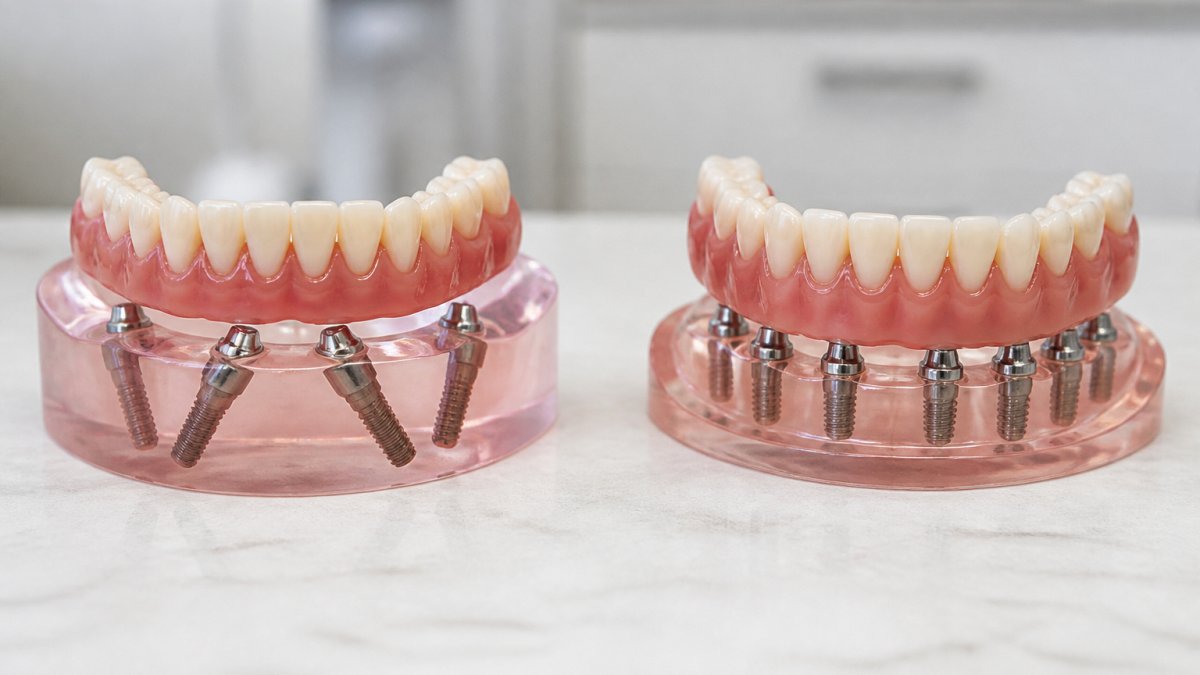
An implant has several parts, and they do not all last the same length of time. The fixture in the bone may survive for decades while the crown, abutment, or prosthesis needs repair or replacement sooner. A crown can chip, wear, or loosen. An abutment screw can loosen. A full-arch prosthesis may need relining or replacement. When you read a survival statistic, ask whether it describes the fixture, the restoration, or the whole assembly, they are different measures with different maintenance expectations.
Warning Signs That Warrant Prompt Assessment
Bleeding or tenderness around the implant collar, gum recession exposing the abutment, a loose crown, persistent bad taste, and any mobility in the fixture itself are reasons to call. Mobility is late-stage and needs immediate attention.
Smoking cessation is the single highest-value change a patient can make. Blood sugar control matters for diabetic patients. Nightguards protect restorations in patients who clench. None of this is exotic, and all of it compounds over decades.
Patients who want to see how our implant program handles long-term care can review our offering and next steps.
Pro Tip Bring your maintenance schedule to every visit and ask for peri-implant probing depths to be recorded. Tracking those numbers over years reveals bone loss trends long before symptoms appear.
Why 20-Year Estimates Vary So Widely
The spread from 75% to 97% at 20 years reflects study design, not just biology. Different studies count different things: some report implant-level survival, others patient-level; some include all implants placed, others only those that completed follow-up.
Sample size drives uncertainty too. The 2024 meta-analysis rested on 237 implants across three prospective studies, which is why its confidence interval spans 15 points.
Outcomes also depend on who plans and places the implant. Our guide on whether one dentist can do all implants explains the single-dentist versus team approach.
The procedure itself is worth understanding before you judge any survival statistic.
Conclusion
Long-term implant success is not a lottery. It is a predictable curve that bends with hygiene, smoking status, gum health, bone quality, and consistent professional monitoring. Patients who understand the difference between survival and success, and who commit to maintenance, sit at the favorable end of every published range.
At Royal Dental at The Villages, we bring 30 years of experience to same-day implants and full-mouth restoration in 24 hours, with IV sedation available for patients who need it and a 10% new-patient discount on dental work and implants. Get started with Royal Dental at The Villages and build an implant plan grounded in realistic, evidence-based expectations.
Frequently Asked Questions
Do dental implants have a high success rate?
Yes. A 2021 cohort of 10,871 implants found 98.5% implant-level survival at 5 years and 96.8% at 10 years. A 2026 study reported 97.0% success at 10 years. Rates decline gradually with time: the same 2021 cohort showed 94.0% at 15 years, and a 2024 meta-analysis estimated 92% at 20 years. Success depends heavily on oral hygiene, smoking status, gum health, and regular professional checkups, so the numbers describe populations rather than any single patient.
Can dental implants fail after 10 years?
Yes. Late failure is less common than early failure but does occur. The 2021 10,871-implant cohort showed implant-level survival dropping from 96.8% at 10 years to 94.0% at 15 years, and a 2026 study reported failure due to lost osseointegration rising from 0.6% to 3.6% between 10 and 25 years. Most late failures trace to peri-implantitis, uncontrolled gum disease, heavy smoking, or skipped maintenance visits. Watch for bleeding gums, swelling, looseness, or discomfort around the implant and report changes promptly.
What can I do to improve the long-term success of a dental implant?
Follow a consistent dental implant maintenance and aftercare routine. Brush twice daily with a soft-bristled brush, clean around the implant and abutment with interdental brushes or water flossers, and attend professional cleanings and checkups on the schedule your dentist sets. Stop smoking or using tobacco, keep diabetes well controlled, and report bleeding, swelling, or looseness early. These steps target the main dental implant failure causes: plaque-driven inflammation, peri-implantitis, and unmanaged systemic risk factors.
How often should dental implants be checked?
Most dentists schedule a checkup and professional cleaning every six months, though your interval may be shorter if you have a history of gum disease, smoke, or have diabetes. Each visit should include probing around the implant, checking for dental implant failure symptoms such as bleeding or deepening pockets, and confirming the crown or prosthesis is secure. Long-term studies rely on regular follow-up, and the same discipline protects your result. Ask your dentist what monitoring schedule fits your risk profile.
Inquiry Services Page
Add royaldentalthevillages.com as a preferred source on Google →


Comments